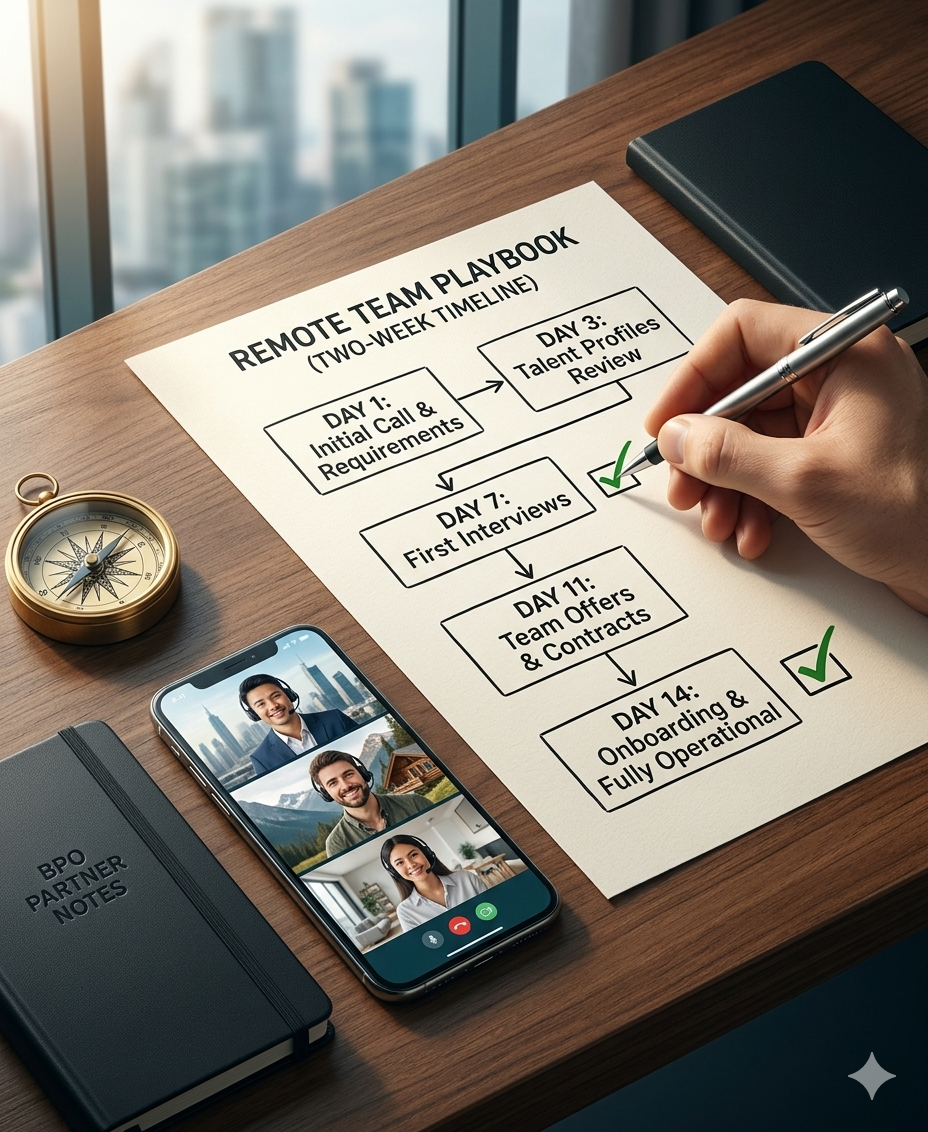
Building a remote team through a BPO partner can go from initial conversation to fully operational staff in as little as two weeks. That sounds aggressive — and it is — but it's a repeatable process when your outsourcing partner has the recruitment pipeline, infrastructure, and onboarding systems already in place. The average time to first hire across our engagements at BE Simple Staffing is 18 days, with full team deployment typically complete within 2-4 weeks.
This playbook walks you through exactly what happens at each stage, what you need to provide, and what your BPO partner should be handling. Whether you're building a customer support team, a bookkeeping function, or a recruitment operation, the timeline follows the same structure.
Week 1: Discovery, role definition, and sourcing
The first week is about alignment. Before a single candidate is sourced, your BPO partner needs to understand your business deeply enough to hire the right people and set them up for success.
Days 1-2: Discovery call and scope definition
This is the most important step in the entire process, and rushing it is the number one mistake companies make when outsourcing. A good discovery process covers:
- What functions are you outsourcing? Be specific. "Customer support" isn't enough — is it phone, email, chat? What products or services? What are the most common inquiry types?
- What does success look like? Define KPIs upfront. Response time targets, accuracy rates, throughput expectations. These become the foundation of the performance management framework.
- What tools does the team need? CRM, ticketing system, accounting software, communication platform. Your BPO partner needs to know the full tech stack before hiring begins.
- What hours do you need covered? Same timezone? Extended hours? Full 24/7 coverage with shift rotations?
- You provide: Process documentation, tool access, brand guidelines, escalation procedures, a point of contact for questions.
- Your BPO partner handles: Job descriptions, sourcing channels, candidate screening, interview scheduling, offer management, workspace setup, hardware provisioning, and compliance.
Days 3-5: Role profiling and candidate sourcing
With the scope defined, your BPO partner builds detailed role profiles and starts sourcing immediately. This is where an established partner has a massive advantage over hiring directly — they already have a pipeline of pre-vetted candidates from previous recruitment cycles.
At BE Simple Staffing, we maintain an active talent database across our core service areas: customer support, bookkeeping, recruitment, and back-office operations. For most roles, we can present qualified candidates within 48-72 hours of scope sign-off.
Sourcing runs in parallel with workspace preparation. While candidates are being identified and screened, the operations team is setting up desks, configuring hardware, and ensuring internet and security infrastructure meets your requirements.
Week 2: Interviews, offers, and workspace deployment
Days 6-8: Client interviews and candidate selection
Your BPO partner should present a shortlist of 2-3 candidates per role, pre-screened for skills, language proficiency, and cultural fit. The client interview is your chance to validate the selection and make final decisions.
Keep these interviews focused. You're not starting from scratch — your partner has already verified the fundamentals. Use your time to assess:
- Communication style and clarity
- Problem-solving approach
- Enthusiasm and cultural alignment with your company
- Any role-specific knowledge or experience
Decision speed matters here. The best candidates in any market get multiple offers. If you find someone strong, move quickly. Aim to confirm selections within 24-48 hours of the interview.
Days 9-10: Offers, contracts, and onboarding preparation
Your BPO partner handles employment contracts, compliance documentation, and all the administrative work that would normally take your HR team weeks. This includes local labor law compliance, tax registration, and benefits enrollment.
Simultaneously, your internal team should be preparing onboarding materials:
- Access credentials for all required tools and systems
- Written SOPs (standard operating procedures) for core tasks
- Brand and communication guidelines
- Escalation flowcharts — who to contact, when, and how
- Sample work or completed examples the new team can reference
Days 11-14: Tech stack deployment and workspace handoff
Hardware is configured with your required software, security protocols are implemented, and communication channels are established. By the end of week two, your remote team should have:
- Dedicated workstations with dual monitors and headsets (for voice roles)
- VPN access configured and tested
- All software installed, licensed, and logged in
- Slack, Teams, or your preferred communication tool set up with the right channels
- Project management tool access (Asana, Monday, Jira, etc.)
Weeks 3-4: Onboarding, training, and first live tasks
Days 15-18: Structured onboarding
The onboarding phase is where most outsourcing engagements succeed or fail. A structured program should include:
- Company orientation: Who you are, what you do, how you work. This matters more than people think — a team that understands your mission performs better than one that just follows scripts.
- Process training: Walk through every SOP, with hands-on practice. Record training sessions so new hires can revisit them.
- Tool training: Guided walkthroughs of every system they'll use daily. Don't assume familiarity — even experienced professionals need to learn your specific configurations.
- Shadow sessions: If possible, have new team members shadow your existing staff (via screen share) for 2-3 days before handling work independently.
Days 19-21: Supervised live work
The team begins handling real tasks with close supervision. Every piece of output is reviewed. Feedback is immediate and specific. This is the calibration period where quality standards are established and reinforced.
Expect productivity to be 50-60% of target during the first week of live work. This is normal. By the end of week three, most teams are operating at 80-90% capacity.
Days 22-28: Ramp to full capacity
Review cadence shifts from real-time to daily check-ins. The team takes on full workload. Performance dashboards go live. Your BPO partner begins regular reporting against the KPIs you defined in week one.
By the end of week four, you should have a fully operational remote team that's integrated into your workflows, hitting its targets, and communicating naturally with your existing staff.
What are the most common mistakes when building a remote team?
After hundreds of team deployments, these are the patterns we see most often:
- Skipping process documentation. If your processes exist only in someone's head, they can't be transferred. Invest the time to write them down before onboarding begins.
- Over-hiring on day one. Start with 2-3 people, prove the model works, then scale. It's much easier to refine processes with a small team than to fix problems across a large one.
- Treating the remote team as separate. Include them in team meetings, share company updates, celebrate wins together. Integration drives retention and performance.
- Expecting perfection immediately. Every team has a ramp-up period. Plan for 3-4 weeks of calibration before expecting full productivity.
- Not assigning a clear internal point of contact. Your remote team needs one person they can go to with questions. Without that, small uncertainties become big delays.
How fast can you realistically scale after the initial team is running?
Once your first team is operational and processes are documented, scaling is significantly faster. Adding new team members to an existing function takes 7-10 days instead of 2-4 weeks, because the infrastructure, training materials, and management layer are already in place.
This is one of the strongest arguments for starting with a BPO partner rather than hiring directly. The partner builds the operational foundation once, and every subsequent hire plugs into that system. Whether you need to add two people or twenty, the process scales linearly.
If you're ready to start building your remote team, talk to BE Simple Staffing. We'll scope your needs, build your timeline, and give you a clear picture of what the first 30 days look like — no guesswork, no surprises.
- A BPO partner can take you from discovery call to operational team in 2-4 weeks, with an 18-day average to first hire.
- Week 1 is about alignment: define roles, KPIs, tools, and working hours before sourcing begins.
- Week 2 covers interviews, offers, and full workspace/tech stack deployment.
- Weeks 3-4 are structured onboarding with supervised live work ramping to full capacity.
- Start small (2-3 people), prove the model, then scale. Adding to an existing team takes 7-10 days.
- The biggest mistake is skipping process documentation — invest the time upfront to avoid costly rework.